


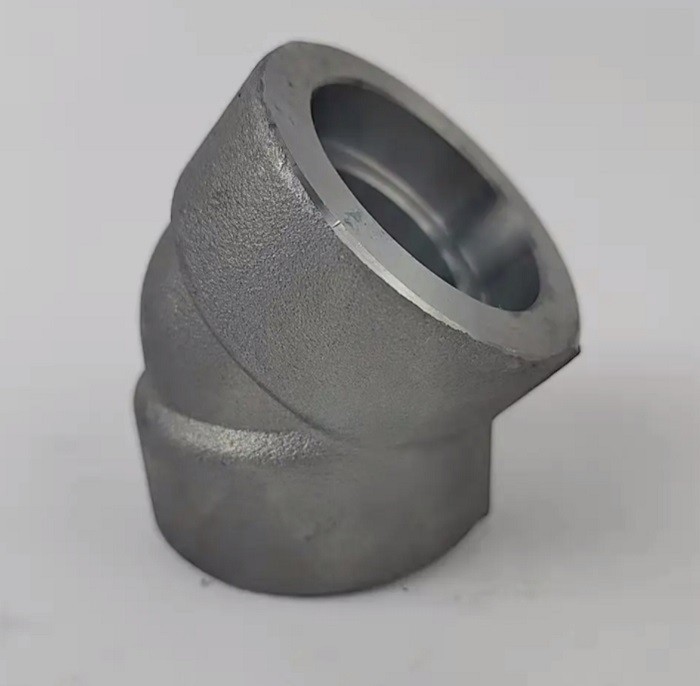


The production process of Forged Elbow Fitting: The forging process generally consists of the following steps: selecting steel billets for cutting, heating, forming, and cooling after forging. The forging process includes free forging, die forging, and membrane forging. During production, different forging methods should be selected based on the quality of the forgings and the quantity of production batches. Free forging has low productivity and large machining allowance, but the tools are simple and versatile, so it is widely used for forging single piece and small batch forgings with simple shapes. Free forging equipment includes air hammers, steam air hammers, and hydraulic presses, which are suitable for the production of small, medium, and large forgings, respectively. Die forging is simple to operate and easy to achieve mechanization and automation.
The size of forged parts, small machining allowance, and reasonable distribution of fiber structure in forged parts can further improve the service life of the parts.
1. The basic process of free Forged Elbow Fitting: During free forging, the shape of the forging is gradually forged from the billet through some basic deformation processes. The basic processes of free forging include upsetting, stretching, punching, bending, and cutting.
1. Overhauling is the process of forging the raw material along the axial direction to reduce its height and increase its cross-section. This process is commonly used for forging gear blanks and other disc-shaped forgings. There are two types of upsetting: full upsetting and partial upsetting.
2. Pulling and elongating is a forging process that increases the length of the billet and reduces its cross-section. It is usually used to produce shaft blanks, such as lathe spindles, connecting rods, etc.
3. Punching is a Forged Elbow Fitting process in which a punch is used to punch through or through holes in a billet.
4. Bending is a forging process that bends the billet into an angle or shape.
5. The forging process of twisting to rotate one part of the billet relative to another.
6. Forging process of cutting and dividing billets or cutting off material heads.


Hot Tags: forged elbow fitting, China forged elbow fitting manufacturers, suppliers, factory, Forged Steel Elbow, forged elbow


