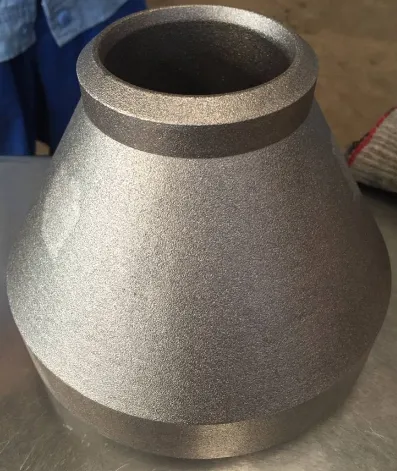
An ASTM A105 Socket Weld Reducing Tee is a forged carbon steel fitting designed to connect three pipes of different nominal sizes in high-pressure socket-weld piping systems.
This fitting is selected when pipe diameters are relatively small, the piping system operates under significant pressure, and a permanent, leak-tight welded connection is required.
Product Specifications
|
Parameter |
Specification |
|
Product |
Socket Weld Reducing Tee |
|
Material Grade |
ASTM A105 / A105M Carbon Steel |
|
Product Type |
Forged Steel Socket Weld Fitting |
|
Dimensional Standard |
ASME B16.11 |
|
Connection Type |
Socket Weld (Fillet Weld) |
|
Configuration |
Reducing Tee |
|
Pressure Classes |
Class 3000, Class 6000, Class 9000 |
|
Size Range |
According to applicable ASME B16.11 size matrix |
|
Manufacturing Method |
Hot forging followed by precision CNC machining |
|
Surface Finish |
Natural forged/machined surface, anti-rust oil or specified coating |
|
Inspection Documents |
Material Test Certificate (MTC) as per EN 10204 3.1 |
Typical Application Environments
Socket weld reducing tees are predominantly utilized in small-bore, high-pressure industrial piping networks where threading is inadequate and butt-welding is impractical.
Oil and Gas Facilities
Auxiliary lines, instrument piping, and small-diameter utility systems.
Petrochemical & Chemical Plants
Process and utility branch connections compatible with carbon steel service.
Power Generation
Boiler auxiliary systems, feedwater lines, and high-pressure utility networks.
Refineries
Small-diameter hydrocarbon processing networks and closed-loop utility systems.
ASTM A105 Material & Metallurgical Considerations
ASTM A105 is the standard specification for forged carbon steel piping components for ambient and higher-temperature service in pressure systems. For a reducing tee, material verification requires more than confirming a surface stamp.
Key Material Evaluation Points:
Heat Number Traceability: Direct link between the finished fitting and the original steel billet test report.
Chemical Composition: Controlled limits for carbon, manganese, phosphorus, sulfur, silicon, and residual elements.
Mechanical Properties: Verification of tensile strength, yield strength, elongation, and reduction of area.
Heat Treatment: As-forged, normalized, or normalized and tempered, depending on forging size and configuration.
Application Boundary Note: ASTM A105 is standard for ambient and elevated temperatures. For low-temperature service requiring notch toughness (impact testing), or severe cyclic/corrosive environments, alternative material specifications must be evaluated against the project piping code.
How to Select the Correct Socket Weld Reducing Tee
Specifying a forged reducing tee requires defining the complete dimensional and rating profile rather than relying solely on nominal descriptions.
Main Run Size: Specify the NPS of the two continuous run connections .
Branch Outlet Size: Define the NPS of the reducing branch, which dictates flow capacity and socket geometry.
Pressure Class: Select between Class 3000, Class 6000, or Class 9000, ensuring compatibility with the matching pipe schedule and design pressure.
Applicable Standard: Confirm ASME B16.11 compliance and whether a specific year edition is required by the project specification.
Pipe Schedule & Wall Compatibility: Verify that the socket bore matches the outside diameter and wall thickness of the connecting pipe to minimize internal flow turbulence and welding misalignment.
Service Parameters: Evaluate design/operating pressure, temperature, fluid medium, and corrosion allowances.
Socket Weld Installation & Fit-Up Factors
Socket-weld installation relies on inserting the pipe into the fitting socket up to a designated bottoming point, leaving a mandatory expansion gap before applying an external fillet weld.
Critical Fit-Up & Machining Parameters:
Socket Depth & Bore
Precision-machined internal diameters to ensure correct pipe clearance without excessive lateral play.
Wall Uniformity
Consistent body and socket wall thickness to withstand thermal stress during welding.
Outlet Alignment
Strict squareness and angular tolerance across all three axes to prevent pipe strain during assembly.
Manufacturing & Internal Quality Control
Producing a reliable forged carbon steel reducing tee involves tightly controlled manufacturing stages:
Raw Material Sourcing & Spectral Analysis
Verification of steel mill test reports and elemental composition of incoming billets.
01
Precision Hot Forging
Shaping the tee geometry using closed-die forging presses to align material grain flow with component contours, avoiding internal micro-voids.
02
Controlled Heat Treatment
Thermal normalization to relieve internal stresses and refine the crystalline microstructure.
03
CNC Machining
Tight-tolerance machining of socket bores, end faces, and center-to-end dimensions per ASME B16.11.
04
In-House Quality Control
Dimensional checks using calibrated gauges, surface imperfection screening, and heat number transfer.
05
Export Packaging & Logistics Protection
For international shipping, forged fittings are protected to prevent transit damage and corrosion:
For international shipping, forged fittings are protected to prevent transit damage and corrosion:
Bundled or boxed in heavy-duty export-grade plywood crates.
Clear external labeling showing item descriptions, heat numbers, quantities, and PO numbers to streamline warehouse receiving.
FAQ
Q: What is the main advantage of a socket-weld reducing tee over a butt-weld reducing tee?
A: Socket-weld reducing tees are specifically designed for small-bore piping systems. They allow quick pipe alignment into the socket recess and eliminate the need for bevel preparation, making installation faster and more efficient in confined spaces while maintaining high pressure ratings.
Q: Are Class 3000, 6000, and 9000 socket-weld fittings interchangeable?
A: No. They feature different wall thicknesses and socket depths designed to match corresponding heavy-wall pipe schedules. Substituting classes without engineering verification compromises system integrity.
Q: How is the size of a reducing tee read?
A: The size is read in three numbers: the first two indicate the size of the continuous run pipe, and the third indicates the size of the branch outlet.
Q: Can ASTM A105 fittings be used in high-temperature applications?
A: ASTM A105 is rated for ambient and elevated temperatures within the limits defined by ASME B16.5 / B16.11 pressure-temperature ratings. For extreme elevated or cryogenic service, alternative alloy or stainless steel specifications are required.
Hot Tags: astm a105 socket weld reducing tee, China astm a105 socket weld reducing tee manufacturers, suppliers, factory