

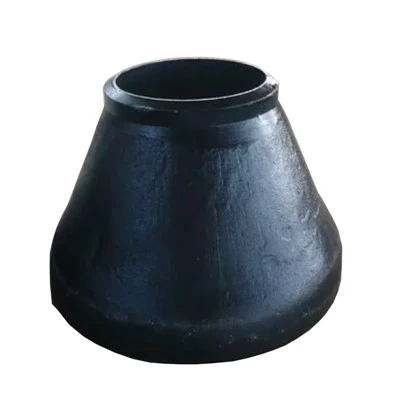

Production process of carbon steel reducing pipe
The production process of carbon steel reducing pipes mainly includes methods such as reducing/expanding diameter pressing, stamping forming, steel plate rolling, strip welding, and dropping. The specific selection depends on product specifications, performance requirements, and application scenarios. The following are the detailed processes and characteristics of each technology:
1. Diameter reduction/expansion pressing process
Core principle: Axial compression is applied to the tube blank through a mold, causing it to shrink or expand into shape.
Process characteristics:
Shrinkage forming: Place a billet with the same diameter as the large end of the reducer into a forming mold, and by pressing along the axial direction of the billet, move the metal along the mold cavity and shrink into shape.
Expanding diameter forming: Using a pipe blank with a diameter smaller than the large end diameter of the reducing pipe, an internal die is used to expand the diameter along the inner diameter of the pipe blank for forming.
Applicable scenarios: Suitable for reducing pipes with large diameter changes. Sometimes, depending on the material and product forming needs, the methods of expanding and reducing the diameter are combined.
Quality control: Determine whether to use cold pressing or hot pressing based on different materials and diameter changes. Normally, cold pressing is preferred, but for cases where multiple diameter changes cause severe work hardening, thick wall thickness, or alloy steel materials, hot pressing is recommended.
2. Stamping forming process
Core principle: Use a die to punch and stretch the steel plate after cutting, and the shape of the die used for stretching is designed according to the dimensions of the inner surface of the reducer.
Process characteristics:
In addition to using steel pipes as raw materials to produce reducers, some specifications of reducers can also be produced using steel plates through stamping forming technology.
Suitable for reducing pipes with special specification requirements.
Application scenario: Suitable for reducing pipes with special specification requirements.
3. Steel plate rolling process
Core principle: Made of rolled steel plates of the same material and thickness as the installed pipeline.
Process characteristics:
The ellipticity after rolling should not exceed 1% of the diameter at each end and should not exceed 5mm.
The centerlines of the two ends of the concentric reducer should coincide, and its eccentricity value (a1-a2)/2 should not exceed 1% of the outer diameter of the large end, and should not exceed 5mm.
Stainless steel and non-ferrous metal pipes are generally made of steel cold rolled reducers.
Application scenario: Suitable for pipelines with larger diameters.
4. Strip welding process
Core principle: Cut several triangles at one end of the pipe, then heat and seal them together, and weld the sealed parts together to make the required reducing pipe.
Process characteristics:
Suitable for reducing pipes with larger diameters and a difference of more than 40mm in diameter between the two ends.
When making concentric reducers, the cut triangle is generally 5-8m in length, forming an isosceles triangle. Its height is taken from the diameter of the larger end of the reducer or slightly larger than the diameter of the larger end. The base size a of the triangle can be calculated according to the following formula:
In the formula, Dw has a large head diameter of mm, dw has a small head diameter of mm, and n represents the number of triangles. For pipes with a diameter of 50-100mm, n=5~6; For pipes with a diameter of 100-400mm, n=6~8.
Application scenario: Suitable for medium and low pressure carbon steel pipeline.


