

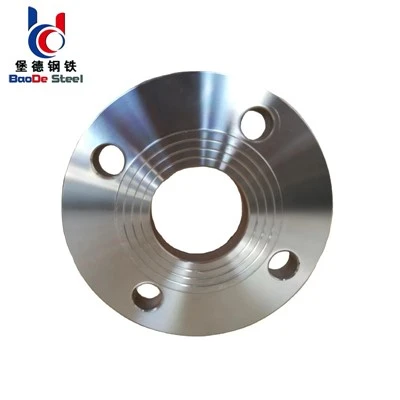
What are the manufacturing processes for BS4504 flanges?
he manufacturing process of BS4504 flange mainly includes forging, casting, cutting and rolling, among which forging and casting are the two most mainstream methods. Different processes directly affect the mechanical properties, applicable scenarios and cost control of the flange.
1, Forged Flange
Forging is the process of heating a metal billet to a plastic state and applying pressure through forging equipment to shape it, resulting in a denser structure and better performance.
Advantages:
Fine grain structure, good streamline, strong tensile and shear resistance
Low carbon content, not easy to rust, especially suitable for high-pressure, high-temperature or corrosive environments
No casting defects such as pores and cracks, more reliable sealing performance
Common methods:
Free forging: suitable for single piece or small batch production, with simple tools but large machining allowance
Model Forging: High precision, smooth surface, suitable for mass manufacturing, uniform crystal structure
Typical applications: industries with high safety requirements such as oil, natural gas, electricity, pharmaceuticals, etc
2, Casting process (Cast Flange)
Casting is the process of pouring molten metal into a mold and cooling it to form, which is suitable for complex structures and has a lower cost.
Advantages:
Can manufacture flanges with complex shapes, such as reinforced ribs or special interfaces
Low cost, suitable for large-scale, low-intensity demand scenarios
Disadvantages:
There may be defects such as pores, inclusions, and cracks inside, and the mechanical properties are relatively weak
The organization is loose, and its compressive and impact resistance is not as good as that of forgings
Special process:
Centrifugal casting: Steel is formed in a high-speed rotating mold, with a denser structure and better quality than ordinary sand casting. It is commonly used in the production of flat welding flanges
Typical applications: Water treatment, HVAC, general industrial piping systems
3, Cutting Plate Flange
Cut the flange blank directly from the steel plate and then machine it.
Process: Material cutting → Cutting inner and outer diameters → Drilling bolt holes → Processing sealing surfaces
Characteristics:
Low material utilization rate, but no need for molds, suitable for temporary needs of medium and low pressure, non-standard sizes
The strength is lower than that of forged flanges, and due to the lack of forging process, the metal fibers are not compacted
Applicable scenarios: small projects, maintenance and replacement, non critical pipeline connections
4, Rolled Flange
Roll the steel plate into a circular shape using a plate rolling machine, weld the joints, and then process it into shape.
Characteristics:
Suitable for large diameter flanges (such as DN1000 and above), solving the size limitations of forging or casting
High cost, but capable of achieving ultra large diameter structures
The quality of the weld seam directly affects the overall strength and requires strict non-destructive testing
Application areas: Heavy equipment such as large wind turbine towers, ships, and offshore platforms


