

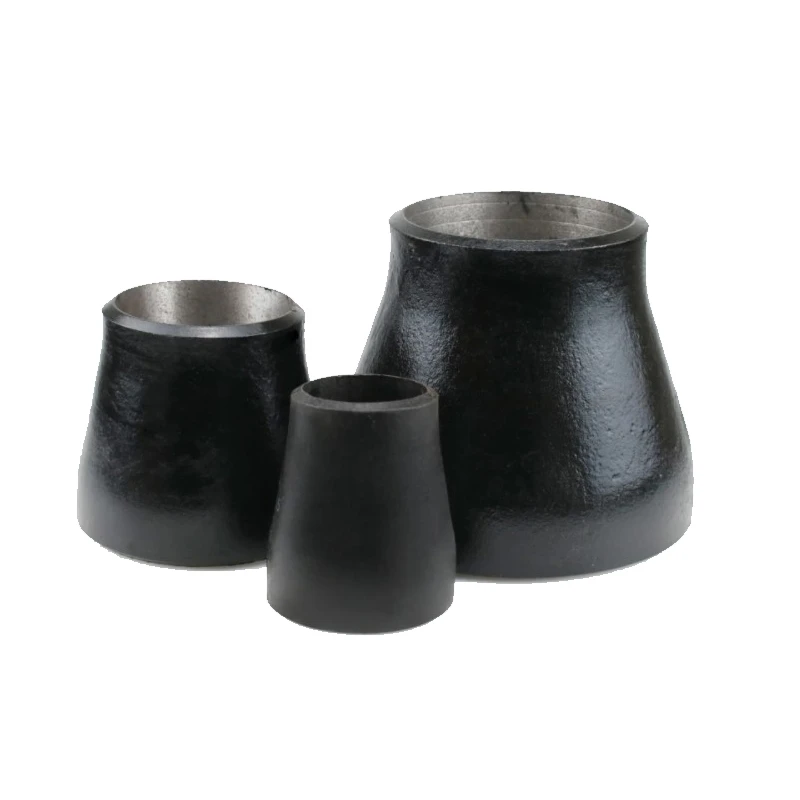

The difference between concentric and eccentric Reducer
The main differences between concentric and eccentric reducers lie in their structural design, stress distribution, and applicable scenarios. The core differences are as follows:
1. Structure and geometric features
Concentric reducer: The centerlines of the two ends of the pipe are located on the same axis, in a conical shape, and the diameter change process is symmetrical and uniform.
Eccentric reducer: The centerline of the two ends of the pipe is offset, with one side parallel (usually at the top or bottom), forming an oblique cone shape, achieving diameter change while keeping one side flat.
2. Installation direction and functional focus
Concentric reducer:
Suitable for vertical pipelines or situations where high flow stability is required.
Beneficial for smooth fluid transition, reducing turbulence and pressure loss, but prone to the formation of gas pockets or liquid accumulation in horizontal pipelines.
Eccentric reducer:
Mostly used for horizontal pipelines, it is installed with "top flat" or "bottom flat" to remove gases or liquids.
Top flat installation (with the tangent point facing upwards): commonly used at pump inlets to facilitate exhaust and prevent cavitation.
Bottom flat installation (with the cutting point facing downwards): used to adjust the valve front, facilitating the discharge of residual liquid and facilitating maintenance.
3. Stress and manufacturing differences
Under internal pressure:
Concentric reducers generate bending moments due to pressure differences in the area, causing the large end to open and the small end to contract.
The eccentric reducer has the highest circumferential stress on the inner surface of the large end on the eccentric side, and attention should be paid to fatigue strength design.
In terms of manufacturing process, both adopt reduced diameter pressing, expanded diameter or stamping forming, and the materials include carbon steel, stainless steel, alloy steel, etc., which comply with standards such as GB/T 12459 and ASME B16.9.


