Hey there! As a supplier of Butt Welded Reducers, I've seen firsthand how the design of reducers can have a huge impact on the flow of fluids. In this blog, I'm gonna break down the key aspects of reducer design and explain how they affect fluid flow.
Understanding the Basics of Reducers
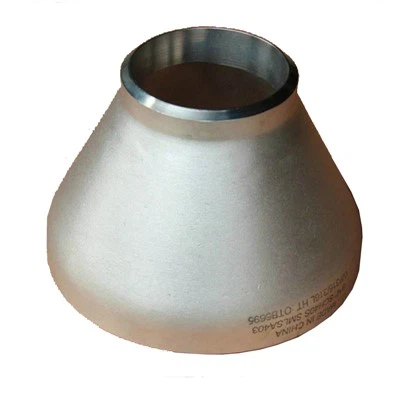
First off, let's quickly go over what a reducer is. A reducer is a pipe fitting that connects two pipes of different diameters. It's used to change the flow rate and pressure of fluids in a piping system. There are two main types of reducers: concentric and eccentric. Concentric reducers have a centered bore, which means the centerline of the smaller pipe is in line with the centerline of the larger pipe. Eccentric reducers, on the other hand, have an offset bore, which is useful for applications where air or solids need to be removed from the fluid.
Impact of Reducer Design on Fluid Flow
Diameter Ratio
One of the most important factors in reducer design is the diameter ratio, which is the ratio of the larger pipe diameter to the smaller pipe diameter. A larger diameter ratio means a more significant change in the cross - sectional area of the pipe. When the fluid flows through a reducer with a large diameter ratio, it experiences a sudden reduction in area. This can lead to an increase in fluid velocity according to the principle of continuity (Q = A1V1=A2V2, where Q is the volumetric flow rate, A is the cross - sectional area, and V is the velocity).


For example, if you have a Carbon Steel Reducer Fittings with a large diameter ratio, the fluid will speed up as it enters the smaller pipe. This increase in velocity can cause several issues. Higher velocities can lead to increased frictional losses, which means more energy is required to pump the fluid through the system. It can also cause erosion of the pipe walls, especially if the fluid contains abrasive particles.
Length of the Reducer
The length of the reducer also plays a crucial role in fluid flow. A short reducer causes a more abrupt change in the cross - sectional area of the pipe, which can create turbulence in the fluid flow. Turbulence is bad news as it increases energy losses and can lead to uneven pressure distribution in the piping system.
On the other hand, a longer reducer allows the fluid to gradually adjust to the change in diameter. This results in a smoother flow with less turbulence. For instance, an ASTM A234 WPB STRUCTURE WELDED CONCENTRIC REDUCER ASME B16.9 with an appropriate length can help maintain a laminar or near - laminar flow, reducing energy consumption and wear on the pipes.
Shape of the Reducer
The shape of the reducer, whether it's concentric or eccentric, affects fluid flow in different ways. Concentric reducers are great for applications where a uniform flow distribution is required. They ensure that the fluid is evenly distributed around the circumference of the pipe, which is important for maintaining a consistent pressure and flow rate.
Eccentric reducers, however, are used when there's a need to prevent the accumulation of air or solids in the fluid. For example, in a piping system that transports a liquid with some suspended solids, an eccentric reducer can be installed in such a way that the solids can settle at the bottom of the pipe and be easily removed.
Real - World Examples
Let's take a look at a real - world scenario. Suppose you're working in an oil refinery, and you need to transport crude oil through a piping system. You might use a 2 Inch To 40mm Reducer at a certain point in the pipeline. If the reducer is poorly designed, with a large diameter ratio and a short length, it can cause the oil to flow at a very high velocity through the smaller pipe. This high - velocity flow can lead to increased frictional losses, which means the pumps have to work harder to maintain the flow. Over time, this can result in higher energy costs and more wear and tear on the equipment.
On the other hand, if you choose a well - designed reducer with an appropriate diameter ratio and length, the oil will flow more smoothly through the system. This not only reduces energy consumption but also extends the lifespan of the piping system.
Considerations for Choosing the Right Reducer
When choosing a reducer for your fluid - handling application, there are several things to keep in mind. First, consider the properties of the fluid, such as its viscosity, density, and whether it contains any abrasive particles. If the fluid is highly viscous, you might need a longer reducer to ensure a smooth flow. If it contains abrasive particles, you'll want to choose a reducer made of a material that can withstand erosion.
Next, think about the flow rate and pressure requirements of your system. A reducer that's too small or too large for your needs can cause problems with fluid flow. You also need to consider the space available for installing the reducer. Sometimes, space constraints might limit your choice between a concentric and an eccentric reducer.
Wrapping Up and Invitation to Connect
In conclusion, the design of a reducer has a significant impact on the flow of fluids in a piping system. From the diameter ratio to the length and shape of the reducer, every aspect needs to be carefully considered to ensure optimal fluid flow.
As a Butt Welded Reducer supplier, I've got a wide range of high - quality reducers that are designed to meet various fluid - handling needs. Whether you're working on a small - scale project or a large industrial application, I can help you find the right reducer for your system.
If you're interested in learning more about our products or have any questions regarding reducer design and fluid flow, don't hesitate to reach out. Let's start a conversation and see how we can work together to improve your fluid - handling system.
References
- White, F. M. (2011). Fluid Mechanics. McGraw - Hill.
- Crane Company. (1988). Flow of Fluids Through Valves, Fittings, and Pipe. Technical Paper No. 410.