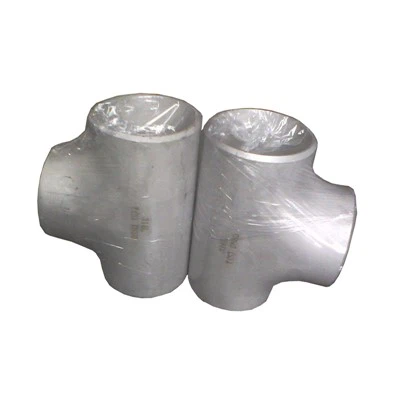
As a seasoned supplier of alloy steel tees, I often encounter inquiries from clients regarding the calculation of stress in these crucial pipe fittings. Understanding how to calculate stress in alloy steel tees is essential for ensuring their safe and efficient use in various applications, from industrial piping systems to plumbing installations. In this blog post, I'll share some insights on the methods and considerations involved in stress calculation for alloy steel tees.
Understanding the Basics of Stress in Alloy Steel Tees
Before delving into the calculation methods, it's important to understand the concept of stress in the context of alloy steel tees. Stress is defined as the force per unit area acting on a material. In the case of alloy steel tees, stress can be caused by various factors, including internal pressure, external loads, thermal expansion, and vibration. Excessive stress can lead to deformation, cracking, or even failure of the tee, which can have serious consequences for the entire piping system.
There are several types of stress that can occur in alloy steel tees, including:
- Tensile stress: This type of stress occurs when a material is pulled apart. In a tee, tensile stress can be caused by internal pressure or external loads.
- Compressive stress: Compressive stress occurs when a material is pushed together. It can be caused by external loads or thermal contraction.
- Shear stress: Shear stress occurs when two parts of a material slide past each other. In a tee, shear stress can be caused by fluid flow or vibration.
- Bending stress: Bending stress occurs when a material is bent. It can be caused by external loads or thermal expansion.
Calculation Methods for Stress in Alloy Steel Tees
There are several methods for calculating stress in alloy steel tees, each with its own advantages and limitations. The choice of method depends on the specific application, the available data, and the level of accuracy required.
Analytical Methods
Analytical methods involve using mathematical equations to calculate stress based on the geometry of the tee, the material properties, and the applied loads. These methods are relatively simple and can provide a quick estimate of stress. However, they often make assumptions that may not be valid in all cases, and they may not account for complex factors such as stress concentrations.
One of the most commonly used analytical methods for calculating stress in tees is the Barlow's formula, which is used to calculate the hoop stress in a thin-walled cylinder. The formula is as follows:
[ \sigma = \frac{P \times D}{2 \times t} ]
Where:
- (\sigma) is the hoop stress
- (P) is the internal pressure
- (D) is the outside diameter of the tee
- (t) is the wall thickness of the tee
This formula can be used to calculate the hoop stress in the main run of the tee, but it does not account for the stress in the branch or the stress concentrations at the junction of the main run and the branch.
Finite Element Analysis (FEA)
Finite Element Analysis (FEA) is a numerical method that uses a computer to simulate the behavior of a structure under various loads. FEA can provide a more accurate and detailed analysis of stress in alloy steel tees than analytical methods, as it can account for complex geometries, material properties, and boundary conditions.
In FEA, the tee is divided into a large number of small elements, and the behavior of each element is analyzed using mathematical equations. The results of the analysis are then combined to provide an overall picture of the stress distribution in the tee.
FEA requires specialized software and expertise, and it can be time-consuming and expensive. However, it is often the preferred method for analyzing complex tee designs or for applications where a high level of accuracy is required.


Experimental Methods
Experimental methods involve testing actual alloy steel tees under controlled conditions to measure the stress. These methods can provide the most accurate data on stress in tees, but they are also the most expensive and time-consuming.
One of the most common experimental methods for measuring stress in tees is strain gauging. Strain gauges are small devices that are attached to the surface of the tee and measure the strain (deformation) of the material. The stress can then be calculated from the strain using the material's modulus of elasticity.
Another experimental method is photoelasticity, which involves using a special material that changes its optical properties when stressed. By shining light through the material and analyzing the resulting patterns, it is possible to measure the stress distribution in the tee.
Considerations for Stress Calculation in Alloy Steel Tees
When calculating stress in alloy steel tees, there are several factors that need to be considered:
- Material properties: The material properties of the alloy steel, such as the yield strength, ultimate strength, and modulus of elasticity, have a significant impact on the stress calculation. It is important to use accurate material properties in the calculation.
- Geometry of the tee: The geometry of the tee, including the diameter, wall thickness, and branch angle, affects the stress distribution. Complex tee geometries may require more advanced calculation methods.
- Applied loads: The applied loads, including internal pressure, external loads, and thermal loads, need to be accurately determined. It is important to consider all possible loads and their combinations.
- Stress concentrations: Stress concentrations can occur at the junction of the main run and the branch, as well as at other locations in the tee. These areas are more likely to experience failure and need to be carefully analyzed.
- Safety factors: It is important to apply appropriate safety factors to the calculated stress to ensure that the tee can withstand the expected loads without failure. The safety factor depends on the application, the level of uncertainty in the calculation, and the consequences of failure.
Applications of Stress Calculation in Alloy Steel Tees
The calculation of stress in alloy steel tees is important in a wide range of applications, including:
- Industrial piping systems: In industrial piping systems, alloy steel tees are used to connect pipes and change the direction of fluid flow. Calculating stress in tees is essential for ensuring the safety and reliability of these systems.
- Plumbing installations: In plumbing installations, alloy steel tees are used to connect water pipes and distribute water to different parts of a building. Understanding the stress in tees can help prevent leaks and other plumbing problems.
- Oil and gas industry: In the oil and gas industry, alloy steel tees are used in pipelines to transport oil and gas. Stress calculation is crucial for ensuring the integrity of these pipelines and preventing environmental disasters.
Conclusion
Calculating stress in alloy steel tees is a complex but essential task for ensuring their safe and efficient use in various applications. By understanding the basics of stress, choosing the appropriate calculation method, and considering the relevant factors, it is possible to accurately calculate the stress in alloy steel tees and design them to withstand the expected loads.
As a supplier of alloy steel tees, I am committed to providing high-quality products that meet the highest standards of safety and reliability. If you have any questions about stress calculation in alloy steel tees or if you are interested in purchasing our products, please feel free to [initiate a contact for procurement discussions]. We offer a wide range of alloy steel tees, including 1 Inch Water Line Tee, Black Pipe Tee, and Black Iron Tee. Our team of experts is always ready to assist you with your specific requirements.
References
- Timoshenko, S. P., & Goodier, J. N. (1970). Theory of Elasticity. McGraw-Hill.
- Budynas, R. G., & Nisbett, J. K. (2011). Shigley's Mechanical Engineering Design. McGraw-Hill.
- ASME Boiler and Pressure Vessel Code, Section VIII, Division 1. American Society of Mechanical Engineers.