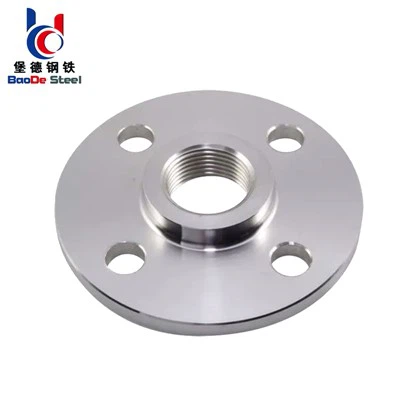
As a supplier of threaded flanges, ensuring the tightness of these crucial components is of utmost importance. Threaded flanges are widely used in various industries, including oil and gas, chemical processing, and water treatment, to connect pipes, valves, and other equipment. A leak in a threaded flange connection can lead to significant safety hazards, environmental pollution, and financial losses. Therefore, proper testing of the tightness of threaded flanges is essential to guarantee the integrity and reliability of the entire piping system. In this blog post, I will share some effective methods for testing the tightness of threaded flanges.
Visual Inspection
The first step in testing the tightness of a threaded flange is a thorough visual inspection. Before installation, carefully examine the flange and the mating components for any signs of damage, such as cracks, scratches, or corrosion. Check the threads for proper alignment and ensure that they are clean and free of debris. Any defects or irregularities in the flange or the threads can compromise the tightness of the connection and should be addressed before proceeding with the installation.
During the installation process, visually inspect the flange connection to ensure that the bolts are tightened evenly and to the specified torque. Uneven tightening can cause the flange to warp or create gaps between the mating surfaces, leading to leaks. Use a torque wrench to ensure that each bolt is tightened to the correct torque value, as specified by the manufacturer or industry standards.


Pressure Testing
Pressure testing is one of the most common and reliable methods for testing the tightness of threaded flanges. This method involves applying a specified pressure to the piping system and monitoring for any leaks. There are two main types of pressure testing: hydrostatic testing and pneumatic testing.
Hydrostatic Testing
Hydrostatic testing involves filling the piping system with a liquid, usually water, and pressurizing it to a specified level. The pressure is maintained for a certain period, typically 10 to 30 minutes, while the system is carefully inspected for any signs of leakage. Hydrostatic testing is preferred for many applications because it is safer and more reliable than pneumatic testing. Water is incompressible, which means that any leaks will result in a visible drop in pressure, making it easier to detect and locate the source of the leak.
To perform a hydrostatic test on a threaded flange connection, follow these steps:
- Isolate the section of the piping system that contains the threaded flange connection.
- Fill the system with water and remove any air pockets by opening the vent valves.
- Gradually increase the pressure to the specified test pressure using a pump.
- Maintain the test pressure for the required duration and carefully inspect the flange connection for any signs of leakage, such as dripping water or wet spots.
- If a leak is detected, mark the location and depressurize the system before making any repairs.
- After the repairs are made, repeat the hydrostatic test to ensure that the leak has been fixed.
Pneumatic Testing
Pneumatic testing involves pressurizing the piping system with a gas, usually air or nitrogen, to a specified level. The pressure is maintained for a certain period, and the system is monitored for any leaks using a soap solution or a leak detector. Pneumatic testing is generally faster and more convenient than hydrostatic testing, but it is also more dangerous because gases are compressible and can cause an explosion if a leak occurs.
To perform a pneumatic test on a threaded flange connection, follow these steps:
- Isolate the section of the piping system that contains the threaded flange connection.
- Purge the system with the test gas to remove any air or moisture.
- Gradually increase the pressure to the specified test pressure using a compressor.
- Apply a soap solution to the flange connection and look for any bubbles, which indicate a leak.
- Alternatively, use a leak detector to monitor the system for any leaks.
- If a leak is detected, mark the location and depressurize the system before making any repairs.
- After the repairs are made, repeat the pneumatic test to ensure that the leak has been fixed.
Ultrasonic Testing
Ultrasonic testing is a non-destructive testing method that can be used to detect leaks in threaded flange connections. This method involves using an ultrasonic transducer to send high-frequency sound waves through the flange and the mating components. Any leaks in the connection will cause the sound waves to reflect differently, which can be detected by the transducer and analyzed by a computer.
Ultrasonic testing is a fast and accurate method for detecting leaks in threaded flange connections, especially in hard-to-reach or inaccessible areas. It can also be used to detect leaks in both metallic and non-metallic flanges. However, ultrasonic testing requires specialized equipment and trained personnel, and it may not be suitable for all types of applications.
Helium Mass Spectrometer Testing
Helium mass spectrometer testing is a highly sensitive method for detecting leaks in threaded flange connections. This method involves using a helium mass spectrometer to detect the presence of helium gas, which is used as a tracer gas. Helium is a very small molecule that can easily penetrate small leaks, making it an ideal tracer gas for detecting even the smallest leaks.
To perform a helium mass spectrometer test on a threaded flange connection, follow these steps:
- Isolate the section of the piping system that contains the threaded flange connection.
- Pressurize the system with helium gas to a specified level.
- Use a helium mass spectrometer to scan the flange connection and detect any leaks.
- If a leak is detected, mark the location and depressurize the system before making any repairs.
- After the repairs are made, repeat the helium mass spectrometer test to ensure that the leak has been fixed.
Helium mass spectrometer testing is a very accurate and reliable method for detecting leaks in threaded flange connections, but it is also very expensive and requires specialized equipment and trained personnel. Therefore, it is usually only used for critical applications where the detection of even the smallest leaks is essential.
Conclusion
Testing the tightness of threaded flanges is a critical step in ensuring the safety and reliability of piping systems. By following the methods outlined in this blog post, you can effectively test the tightness of threaded flanges and detect any leaks before they cause serious problems. As a threaded flange supplier, I am committed to providing high-quality products and ensuring that they meet the highest standards of safety and reliability. If you have any questions or need further information about testing the tightness of threaded flanges, please do not hesitate to [contact me for procurement and negotiation].
References
- ASME B31.3 Process Piping Code
- API 6A Specification for Wellhead and Christmas Tree Equipment
- ISO 15156 Petroleum and natural gas industries — Materials for use in H2S-containing environments in oil and gas production