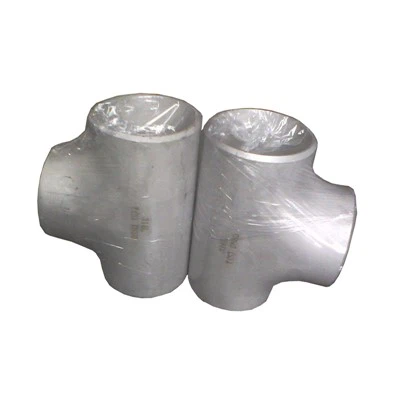
Alloy steel tees are essential components in various industrial applications, known for their strength, durability, and resistance to different environmental factors. One of the critical properties that make alloy steel tees highly sought - after is their creep resistance. As a leading alloy steel tee supplier, I am well - versed in the intricacies of this property and its significance in real - world applications.
Understanding Creep
Creep is a time - dependent deformation that occurs under a constant load at elevated temperatures. When a material is subjected to a load over an extended period at high temperatures, it gradually deforms, even if the stress is below the yield strength of the material. This deformation can lead to failure of the component if not properly accounted for. In the case of alloy steel tees, creep can be a major concern, especially in applications where they are exposed to high - temperature and high - pressure conditions, such as in power plants, refineries, and chemical processing industries.
Factors Affecting Creep Resistance of Alloy Steel Tees
Chemical Composition
The chemical composition of alloy steel plays a crucial role in determining its creep resistance. Alloying elements such as chromium (Cr), molybdenum (Mo), vanadium (V), and nickel (Ni) are often added to carbon steel to improve its creep properties. Chromium forms a protective oxide layer on the surface of the steel, which helps to prevent oxidation and corrosion at high temperatures. Molybdenum enhances the strength and creep resistance of the steel by forming carbides that impede the movement of dislocations within the crystal lattice. Vanadium also contributes to the formation of fine carbides, which further strengthen the steel and improve its creep resistance. Nickel improves the toughness and ductility of the steel, which can help to prevent brittle failure during creep.
Microstructure
The microstructure of alloy steel also has a significant impact on its creep resistance. A fine - grained microstructure generally provides better creep resistance than a coarse - grained microstructure. This is because the grain boundaries act as barriers to the movement of dislocations, which are responsible for the deformation during creep. Heat treatment processes such as normalizing, quenching, and tempering can be used to control the microstructure of the alloy steel and improve its creep properties.
Temperature and Stress
The temperature and stress levels to which the alloy steel tee is exposed are the most obvious factors affecting creep. Higher temperatures and stresses accelerate the creep process. In industrial applications, it is essential to carefully consider the operating temperature and stress conditions when selecting an alloy steel tee. Design engineers need to ensure that the tee is capable of withstanding the expected temperature and stress levels over its service life.
Testing Creep Resistance
To accurately assess the creep resistance of alloy steel tees, various testing methods are employed. One of the most common methods is the creep test, where a specimen of the alloy steel is subjected to a constant load at a specific temperature for an extended period. The deformation of the specimen is measured over time, and the creep rate is calculated. Another method is the stress - rupture test, which involves applying a constant load to the specimen until it fails. The time to failure and the stress at failure are recorded, and these data are used to evaluate the long - term creep performance of the material.
Applications of Alloy Steel Tees with High Creep Resistance
Power Generation
In power plants, alloy steel tees are used in high - temperature and high - pressure steam pipelines. The steam in these pipelines can reach temperatures of up to 600°C or more, and the tees need to have excellent creep resistance to ensure the safe and reliable operation of the power plant. Our alloy steel tees, with their high creep resistance, are ideal for such applications, as they can withstand the harsh conditions and maintain their integrity over long periods.
Oil and Gas Refineries
In oil and gas refineries, alloy steel tees are used in various processes, such as cracking, distillation, and hydrotreating. These processes often involve high - temperature and high - pressure conditions, and the tees need to be able to resist creep to prevent leaks and failures. Our alloy steel tees are suitable for use in these refineries, providing a reliable solution for fluid distribution in complex piping systems. For example, Gas Line Tee Fitting is a product specifically designed for gas - related applications in refineries.
Chemical Processing
Chemical processing plants use alloy steel tees in pipelines that carry corrosive chemicals at high temperatures. The creep resistance of the tees is crucial to prevent deformation and failure, which could lead to chemical spills and safety hazards. Our alloy steel tees are formulated to resist both corrosion and creep, making them a perfect choice for these demanding applications.
Our Offerings as an Alloy Steel Tee Supplier
As an alloy steel tee supplier, we offer a wide range of products with different chemical compositions and dimensions to meet the diverse needs of our customers. Our 1 Inch Tee Fitting and 1 Inch Water Line Tee are just a few examples of our product portfolio. We use advanced manufacturing techniques and strict quality control measures to ensure that our alloy steel tees have high creep resistance and meet the relevant industry standards.
We work closely with our customers to understand their specific requirements and provide them with the most suitable alloy steel tee solutions. Our technical team is available to offer advice on material selection, installation, and maintenance to ensure the optimal performance of our products.
Contact for Procurement
If you are in need of high - quality alloy steel tees with excellent creep resistance for your industrial applications, we invite you to contact us for procurement discussions. Our team is ready to assist you in finding the right products that meet your specific needs and budget. We are committed to providing you with the best - in - class alloy steel tees and outstanding customer service.


References
- ASM Handbook, Volume 1: Properties and Selection: Irons, Steels, and High - Performance Alloys. ASM International.
- Callister, W.D. & Rethwisch, D.G. Materials Science and Engineering: An Introduction. Wiley.
- “Creep of Metals and Alloys” by B. Wilshire and R. W. Evans. Institute of Materials, Minerals and Mining.