What is the effect of alloy steel tee on fluid flow velocity?
As an alloy steel tee supplier, I've had countless in - depth discussions with customers, engineers, and industry experts about the unique properties and applications of alloy steel tees. One recurring and fascinating topic is how these tees influence fluid flow velocity.
Basics of Fluid Flow in a Pipe System
Before we delve into the specifics of alloy steel tees, it's essential to have a basic understanding of fluid flow in a pipe. In a simple straight pipe, fluid flow can be described using well - known principles such as the Hagen - Poiseuille's law for laminar flow or the Darcy - Weisbach equation for turbulent flow. The velocity of the fluid in a straight pipe is determined by factors like the pressure difference across the pipe, the pipe's diameter, and the viscosity of the fluid.
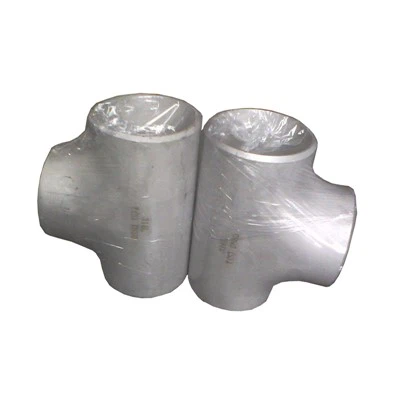
However, when we introduce an alloy steel tee into the system, the situation becomes more complex. An alloy steel tee is a type of pipe fitting that has a T - shaped structure. It allows a fluid to split or combine flows at a junction. These tees are made from alloy steel, which is a combination of iron with other elements like chromium, nickel, and molybdenum, giving them enhanced strength, corrosion resistance, and durability compared to regular steel.
Impact on Flow Splitting
When a fluid reaches an alloy steel tee and the flow splits, the velocity of the fluid in each branch is affected. According to the principle of conservation of mass, the mass flow rate entering the tee must be equal to the sum of the mass flow rates leaving the tee. If the cross - sectional areas of the branches are different, the fluid velocities in the branches will vary.


For example, consider Black Pipe Tee where the main pipe has a relatively large cross - sectional area, and it splits into two smaller branches. As the fluid enters the tee, the total area available for flow suddenly changes. The fluid will redistribute itself among the branches in such a way that the mass flow is conserved. If the cross - sectional area of one branch is half of the other, assuming the densities remain constant, the fluid velocity in the smaller - area branch will be higher than that in the larger - area branch.
This change in velocity has several implications. In industrial applications, a higher velocity in a pipe can lead to increased friction losses. The Darcy - Weisbach equation shows that the head loss due to friction is proportional to the square of the fluid velocity. So, in the branch of the alloy steel tee with a higher velocity, there will be more energy dissipated as heat due to friction between the fluid and the pipe wall.
Flow Combining
When fluid flows from two or more branches into the main section of an alloy steel tee (flow combining), the situation is also interesting. The incoming fluid streams from different branches have their own velocities and directions. At the junction of the tee, these streams interact, and the final velocity of the combined fluid in the main pipe is determined by the momentum of the incoming streams.
Let's take the 1 Inch Water Line Tee as an example. If two streams of water with different velocities are combining at the tee, the momentum of each stream (which is the product of mass, velocity, and direction) plays a crucial role. In an ideal situation, if the two incoming streams have the same density and one stream has a higher velocity while the other has a lower velocity, the combined fluid velocity in the main pipe will be somewhere between these two velocities, weighted by the mass flow rates of the individual streams.
However, in real - world scenarios, there are additional factors. Turbulence is often generated at the junction as the two streams mix. This turbulence can cause further changes in the velocity profile of the fluid. High - velocity streams can cause eddies and swirls, which can disrupt the smooth flow of the combined fluid. These disturbances can lead to increased head losses and uneven distribution of velocity across the cross - section of the main pipe.
Design and Its Influence on Flow Velocity
The design of the alloy steel tee also has a significant impact on fluid flow velocity. For instance, the radius of curvature at the corners of the tee can affect the flow behavior. A tee with a larger radius of curvature at the corners will result in a smoother flow transition compared to a tee with sharp corners.
A Butt Weld Tee Fitting is often preferred in systems where a more streamlined flow is required. The smooth weld and the lack of abrupt changes in the pipe wall help to minimize turbulence. When the flow is less turbulent, the velocity distribution across the cross - section of the pipe is more uniform, and the overall pressure drop in the system is reduced.
The angle at which the branches are attached to the main pipe also matters. In a standard 90 - degree tee, the fluid experiences a more abrupt change in direction compared to a tee with a smaller branch angle. A smaller branch angle allows the fluid to gradually change its direction, which can lead to a more stable flow and less disruption of the velocity profile.
Practical Applications and Considerations
In many industrial applications, understanding the effect of alloy steel tees on fluid flow velocity is crucial. In a chemical processing plant, for example, accurate control of fluid velocity is necessary to ensure proper mixing of chemicals. If the velocity in one branch of a tee is too high, it may cause uneven distribution of a reactant, leading to incomplete reactions or the formation of unwanted by - products.
In a plumbing system, proper management of fluid velocity is essential to prevent water hammer, a phenomenon where sudden changes in fluid velocity create pressure surges in the pipes. Using the right alloy steel tee with appropriate design and sizing can help mitigate these issues.
In the oil and gas industry, where large - scale fluid transportation occurs, alloy steel tees are used extensively. The ability to predict and control fluid flow velocity is vital for efficient operation and safety. High - velocity flows can cause erosion of the pipe walls, especially in the areas near the tee junctions. By carefully selecting the alloy steel tee and optimizing the system design, operators can minimize the risk of erosion and extend the lifespan of the piping system.
Conclusion
As an alloy steel tee supplier, I've witnessed firsthand the importance of these fittings in a wide range of fluid - handling applications. The effect of alloy steel tees on fluid flow velocity is a multi - faceted phenomenon that is influenced by factors such as flow splitting, flow combining, tee design, and the specific requirements of the application.
Whether you are involved in industrial manufacturing, plumbing, or the energy sector, understanding how alloy steel tees impact fluid flow velocity can lead to more efficient, reliable, and cost - effective operations. If you are considering using alloy steel tees in your project and need more information on how they can be optimized for your specific fluid - flow needs, I invite you to reach out. I'm ready to share my expertise and provide high - quality alloy steel tees that meet your requirements. Let's start a conversation about your project and find the best solutions together.
References
- White, F. M. (2016). Fluid Mechanics. McGraw - Hill Education.
- Pinder, G. F. (2001). Ground Water Hydrology. Prentice - Hall.
- Munson, B. R., Young, D. F., & Okiishi, T. H. (2009). Fundamentals of Fluid Mechanics. Wiley.