

[TL;DR] For most oil, gas, steam and general industrial lines, carbon steel elbows (ASTM A234 WPB / A420 WPL6) deliver the best strength-per-dollar. For corrosive, marine, chemical or food-grade lines, stainless steel elbows (ASTM A403, grades 304/316/316L) pay back their higher price through longer service life and near-zero maintenance. Tianjin Baode Steel Co., Ltd. manufactures both in one ISO 9001/14001/45001-certified factory, with common stocked sizes shipped in 5-7 days.
Choosing the wrong elbow material rarely shows up on day one. It shows up eighteen months later, when a carbon steel fitting starts weeping rust inside a chemical line, or when a stainless steel elbow on a simple water-supply project quietly blows the budget for no real benefit. For procurement teams and EPC buyers sourcing pipe fittings from China, the elbow - the single most-used fitting in any pipeline - is where this material decision gets made first. This guide compares carbon steel and stainless steel elbows on the factors that actually drive a purchase order: pressure rating, corrosion exposure, certification, and total cost of ownership, using real production specs from Tianjin Baode Steel Co., Ltd.
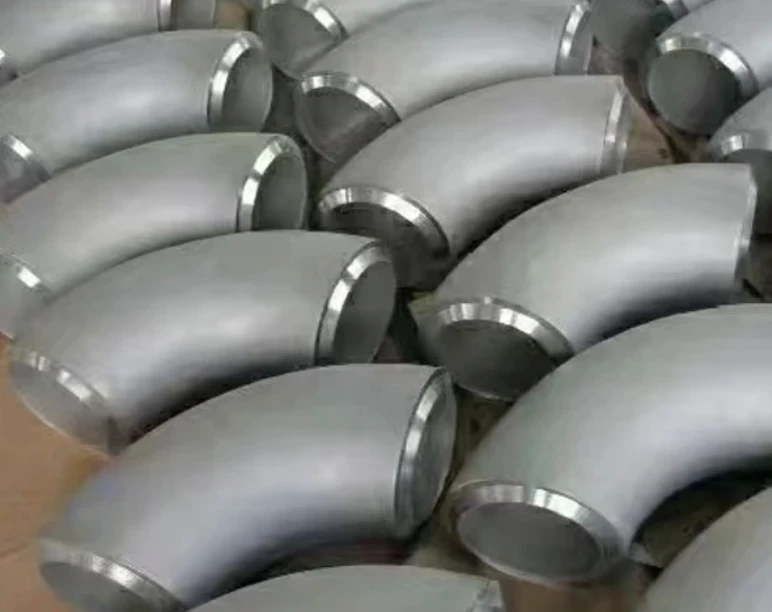
Carbon Steel Elbow: Built for Pressure, Priced for Volume
Carbon steel elbows remain the default choice for most industrial pipelines because they combine high mechanical strength with the lowest cost per ton among structural fittings. Baode produces them to ASTM A234 WPB for standard service and ASTM A420 WPL6 for low-temperature duty down to -45°C (-50°F), Charpy V-notch impact tested, tensile strength ≥485MPa, yield strength ≥275MPa. Sizes run 1/2"-24" seamless and up to 48" welded, in 45°, 90° and 180° long-radius (1.5D) and short-radius (1.0D) configurations to ASME B16.9.
Where it earns its place: oil & gas trunk lines, power and steam piping, urban gas networks, water treatment and construction - anywhere the fitting will be galvanized, epoxy-coated or painted after installation to offset its main weakness, corrosion.
Stainless Steel Elbow: Corrosion Resistance That Lowers Lifetime Cost
Stainless steel elbows cost more per piece, but for the right application they remove an entire category of maintenance risk. Produced to ASTM A403 in grades 304, 304L, 316, 316L, 321 and 347, they resist rust and chemical attack without secondary coating. The grade matters on the PO: 304 covers general industrial and civil piping at moderate cost; 316 adds molybdenum for chloride and marine resistance; 316L's lower carbon content resists intergranular corrosion after welding, making it standard for food and pharmaceutical lines.
Connection options include welding (TIG/MIG), threaded and flange connection. Common stocked sizes ship in 5-7 days; custom or large-volume orders run 25-30 days after deposit.

Carbon Steel vs Stainless Steel Elbow: Side-by-Side Comparison
| Comparison | Carbon Steel Elbow | Stainless Steel Elbow |
| Common Standard | ASTM A234 WPB / A420 WPL6 | ASTM A403 (304/304L/316/316L/321) |
| Corrosion Resistance | Low - needs coating/galvanizing | High - no coating required |
| Relative Material Cost | Lower | 2-4x higher, depending on grade |
| Best Service Range | Down to -45°C (WPL6); strong under high pressure | Wide range; excels at high-temp & corrosive duty |
| Typical Industries | Oil & gas, power, urban gas, construction | Chemical, marine, food & pharma, offshore |
| Surface Treatment | Galvanizing / epoxy / powder coating recommended | None required |
| Lead Time (stocked sizes) | 5-7 days | 5-7 days |
How to Choose the Right Elbow Material in 5 Steps
|
1
|
Map the media. Identify what's flowing - water, steam, crude oil, chemicals, or food product. Corrosive or high-chloride media points straight to stainless steel. |
|
2
|
Check operating temperature. Below -29°C, ask for WPL6 carbon steel or a suitably rated stainless grade with impact test data. |
|
3
|
Confirm the pressure class. Match wall thickness (schedule) and standard (ASME B16.9) to your line's design pressure. |
|
4
|
Price the coating, not just the fitting. A galvanized carbon steel elbow plus recoating cycles over 10 years can end up costing more than stainless bought once. |
|
5
|
Request mill test certificates. Ask for ISO 9001-traceable material certs, and NACE MR0175 compliance for sour or duplex-grade service. |
Why Global Buyers Source Both Materials From One Factory
Tianjin Baode Steel Co., Ltd. was established in 2006 (formerly Cangzhou Junde Steel Pipe Co., Ltd., renamed in 2019). Its pipe-fitting production base, Hongcheng Pipe Industry Co., Ltd. in Yanshan County, Cangzhou, was built in 1992, covers 100,000 m², and employs 520 people. The plant runs elbow-pushing machines, tee-forming machines and press equipment covering 1/2"-24" seamless up to 48" welded fittings in carbon, stainless and alloy steel, with annual fitting output over 20,000 tons. The company holds ISO 9001, ISO 14001 and ISO 45001 certification and AAA Credit Enterprise status, exporting to 40+ countries across North America, South America, Southeast Asia, the Middle East and Africa.
|
1992 Factory established |
520 Employees |
100,000 m² Production base |
20,000+ t Annual fitting output |
40+ Export countries |
FAQ: Carbon Steel & Stainless Steel Elbow Sourcing
What is the price difference between carbon steel and stainless steel elbow?
Stainless steel elbows typically cost 2-4x more than carbon steel per piece due to alloy content (chromium, nickel, molybdenum), but they require no coating and last longer in corrosive conditions.
What grade should I specify for a carbon steel elbow in low-temperature service?
ASTM A420 WPL6, Charpy V-notch impact tested at -45°C (-50°F), with tensile strength ≥485MPa and yield strength ≥275MPa.
What's the difference between 304 and 316 stainless steel elbow?
316 adds molybdenum for stronger resistance to chlorides and marine/offshore corrosion; 304 is the standard, lower-cost grade for general industrial and civil piping.
What is the standard lead time for stocked stainless steel elbow sizes?
Common stocked items ship in 5-7 days. Large-volume or custom orders take about 25-30 days after deposit.
Does Tianjin Baode Steel accept custom sizing and marking?
Yes. Both size and marking can be customized to the buyer's drawings or project specification, in either carbon or stainless steel.
What are the standard payment terms?
30% by T/T or L/C as deposit, with the balance paid before shipment.
There's no universally "better" elbow - only the right material for the medium, temperature and budget in front of you. Carbon steel wins on cost and pressure handling; stainless steel wins on corrosion life and hygiene. Tianjin Baode Steel Co., Ltd. produces both to the same ISO-certified process, along with matching tees, reducers and flanges, so switching material doesn't mean switching supplier.
Need a Technical Review or Quote on Carbon Steel or Stainless Steel Elbows?
Send your pipe spec - size, schedule, and standard - for a same-day quotation from Tianjin Baode Steel Co., Ltd.
Request a Quote Chat on WhatsApp


