Hey there! As a supplier of blind flanges, I often get asked about the dimensions of these essential components. So, let's dive right in and explore what makes up the dimensions of a blind flange.
First off, what exactly is a blind flange? Well, it's a type of flange that's used to close the end of a piping system or a vessel. It doesn't have a bore in the center like other flanges, which makes it perfect for sealing off pipelines when you don't need to connect anything else. Blind flanges are super important in a bunch of industries, like oil and gas, chemical processing, and water treatment.
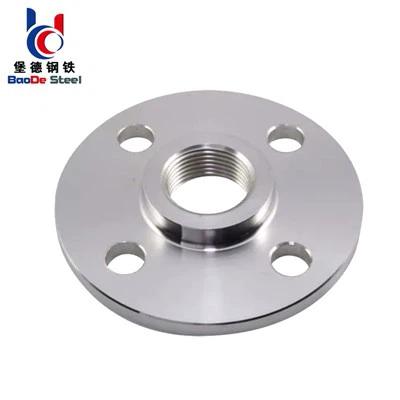
Now, let's talk about the key dimensions of a blind flange. The main ones we'll focus on are the outside diameter (OD), the bolt circle diameter (BCD), the number of bolt holes, the diameter of the bolt holes, and the thickness.
The outside diameter is, as the name suggests, the measurement across the outside edge of the flange. It's a crucial dimension because it determines how the flange will fit into the overall piping system. A larger OD might be needed for bigger pipes or when you need more surface area for sealing.
The bolt circle diameter is the diameter of the circle formed by the centers of the bolt holes. This dimension is vital because it ensures that the bolts will line up correctly when you're installing the flange. If the BCD is off, the bolts won't fit properly, and you'll have a leaky mess on your hands.
The number of bolt holes is also an important factor. It depends on the size of the flange and the pressure it needs to withstand. Generally, larger flanges will have more bolt holes to provide a stronger seal.
The diameter of the bolt holes is another key dimension. It has to match the size of the bolts you're using. If the holes are too small, the bolts won't fit. If they're too big, the bolts won't hold the flange securely.
Finally, the thickness of the blind flange is crucial for its strength and durability. Thicker flanges can handle higher pressures and are more resistant to deformation.


Let's take a look at some common types of blind flanges and their dimensions. One popular type is the Flange Blind Plates Flange Blind Plates. These are simple, flat flanges that are used for basic sealing applications. They come in a variety of sizes and thicknesses to suit different needs.
Another type is the RF Blind Flanges RF Blind Flanges. RF stands for Raised Face, which means there's a raised area around the center of the flange. This raised face helps to create a better seal when the flange is bolted to another component.
For example, let's consider a 2 INCH 150# RF BLIND FLANGE 2 INCH 150# RF BLIND FLANGE. The "2 INCH" refers to the nominal pipe size, which is a standard way of specifying the size of pipes and flanges. The "150#" indicates the pressure rating, which means this flange is designed to handle a certain amount of pressure. The RF part, as we mentioned earlier, means it has a raised face.
When it comes to the dimensions of this 2 INCH 150# RF BLIND FLANGE, the outside diameter might be around 7 inches, the bolt circle diameter could be about 5.5 inches, it might have 4 bolt holes with a diameter of about 0.875 inches, and the thickness could be around 0.75 inches. These dimensions can vary slightly depending on the manufacturer and the specific standards they follow.
It's important to note that there are different standards for blind flange dimensions around the world. The most common ones are the ASME (American Society of Mechanical Engineers) standards in the United States and the DIN (Deutsches Institut für Normung) standards in Europe. These standards ensure that flanges from different manufacturers are interchangeable and that they meet certain quality and safety requirements.
So, if you're in the market for blind flanges, make sure you know the exact dimensions you need. It's a good idea to work with a reliable supplier who can help you choose the right flange for your application. And that's where we come in! As a supplier of high-quality blind flanges, we have a wide range of sizes and types to meet your needs. Whether you need a small flange for a home plumbing project or a large flange for an industrial application, we've got you covered.
If you're interested in purchasing blind flanges or have any questions about their dimensions, feel free to reach out to us. We're always happy to help you find the perfect flange for your project.
References:
- ASME B16.5 - Pipe Flanges and Flanged Fittings
- DIN Standards for Flanges
So, don't hesitate to get in touch if you're looking for top-notch blind flanges. We're here to make sure you get the right product at the right price. Let's start a conversation about your flange needs today!