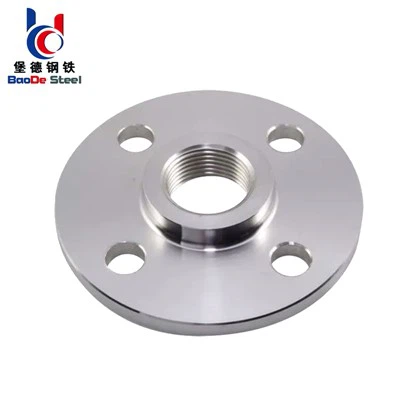
Hey there! I'm a supplier of threaded flanges, and today I wanna talk about the testing methods for these bad boys. Threaded flanges are crucial components in many piping systems, so it's super important to make sure they're up to snuff.
Visual Inspection
First off, visual inspection is like the bread and butter of testing threaded flanges. It's the most basic but also one of the most important steps. When you get a batch of threaded flanges, you gotta take a good look at 'em. Check for any obvious defects like cracks, pits, or scratches on the surface. These flaws can weaken the flange and lead to leaks or failures down the line.
You also wanna make sure the threading is in good shape. The threads should be clean, sharp, and evenly spaced. If the threads are damaged or worn out, it can cause problems when you're trying to connect the flange to the pipe. And don't forget to check the overall dimensions of the flange. It should match the specifications you ordered. Any deviations could mean that the flange won't fit properly in your system.
Dimensional Testing
Dimensional testing goes hand in hand with visual inspection. You need to measure the key dimensions of the threaded flange to make sure it meets the required standards. This includes things like the outer diameter, inner diameter, thickness, and the pitch of the threads.

There are different tools you can use for dimensional testing. For example, calipers are great for measuring small dimensions accurately. You can use them to check the thickness of the flange or the diameter of the bore. For larger dimensions, a micrometer or a tape measure might be more appropriate.
It's important to follow the correct measurement procedures to get accurate results. Make sure you're measuring at the right points and using the right units. And don't forget to record your measurements so you can keep track of the quality of the flanges.
Pressure Testing
Pressure testing is another crucial test for threaded flanges. This test helps you determine if the flange can withstand the pressure it'll be subjected to in the actual piping system. There are two main types of pressure testing: hydrostatic testing and pneumatic testing.
Hydrostatic Testing
Hydrostatic testing involves filling the flange and the connected piping with water and then pressurizing it to a specified level. The pressure is usually maintained for a certain period of time, typically around 10 to 30 minutes. During this time, you need to check for any leaks or signs of deformation.
The advantage of hydrostatic testing is that water is an incompressible fluid, so it provides a more accurate representation of the actual pressure the flange will experience in a real system. However, it can be a bit messy and time-consuming, especially if you're testing a large number of flanges.
Pneumatic Testing
Pneumatic testing, on the other hand, uses air or another gas instead of water. It's a faster and cleaner method, but it's also more dangerous because gases are compressible. If there's a sudden leak during pneumatic testing, it can cause a lot of damage.
When performing pneumatic testing, you need to be extra careful. Make sure you have proper safety measures in place, such as pressure relief valves and protective barriers. And always follow the relevant safety standards and regulations.
Material Testing
The quality of the material used to make the threaded flange is just as important as its dimensions and pressure resistance. Material testing helps you determine the chemical composition and mechanical properties of the flange.
Chemical Analysis
Chemical analysis is used to identify the elements present in the flange material. This can help you make sure that the material meets the required specifications. For example, if the flange is supposed to be made of stainless steel, the chemical analysis should show the correct amounts of chromium, nickel, and other elements.
There are different methods for chemical analysis, such as spectroscopy and wet chemical analysis. Spectroscopy is a non-destructive method that uses light to analyze the chemical composition of the material. Wet chemical analysis, on the other hand, involves dissolving a small sample of the material in a chemical solution and then analyzing the resulting solution.
Mechanical Testing
Mechanical testing is used to determine the mechanical properties of the flange material, such as its strength, hardness, and ductility. There are several types of mechanical tests, including tensile testing, hardness testing, and impact testing.

Tensile testing involves pulling a sample of the flange material until it breaks. This test helps you determine the ultimate tensile strength and the yield strength of the material. Hardness testing, on the other hand, measures the resistance of the material to indentation. Impact testing is used to determine the material's ability to absorb energy when subjected to a sudden impact.
Non-Destructive Testing (NDT)
Non-destructive testing methods are used to detect internal defects in the threaded flange without damaging it. These methods are especially useful for detecting defects that are not visible on the surface.

Ultrasonic Testing
Ultrasonic testing uses high-frequency sound waves to detect internal defects in the flange. The sound waves are sent into the material, and any defects will cause the waves to reflect back. By analyzing the reflected waves, you can determine the location and size of the defects.
Magnetic Particle Testing
Magnetic particle testing is used to detect surface and near-surface defects in ferromagnetic materials. The flange is magnetized, and then iron particles are applied to the surface. If there are any defects, the magnetic field will be disrupted, and the iron particles will accumulate at the defect sites, making them visible.
Dye Penetrant Testing
Dye penetrant testing is used to detect surface defects in non-porous materials. A colored dye is applied to the surface of the flange, and then the excess dye is removed. A developer is then applied, which will draw the dye out of any defects, making them visible.
Conclusion
So there you have it, folks! These are some of the main testing methods for threaded flanges. As a supplier, I know how important it is to ensure the quality of our products. That's why we use a combination of these testing methods to make sure that every threaded flange we supply meets the highest standards.
If you're in the market for high-quality threaded flanges, like our Threaded Welded Flange, don't hesitate to reach out. We're here to provide you with the best products and services. Whether you have a small project or a large industrial application, we've got the right threaded flanges for you. Contact us today to start the procurement process and let's work together to make your piping system a success!
References
- ASME B16.5: Pipe Flanges and Flanged Fittings
- ASTM A105: Standard Specification for Carbon Steel Forgings for Piping Applications
- API 6A: Specification for Wellhead and Christmas Tree Equipment