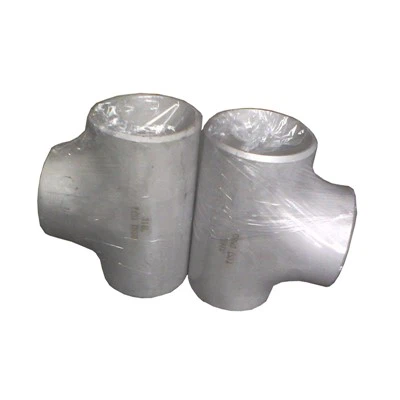
Hey there! As a supplier of alloy steel tees, I often get asked about how we check for internal defects in these products. It's a crucial step in ensuring the quality and reliability of our alloy steel tees, so I'm gonna share some of the common inspection methods we use.
Visual Inspection
Let's start with the simplest one - visual inspection. This is usually the first step in our quality - control process. We take a good, close look at the surface of the alloy steel tee. Even though it's mainly for surface defects, sometimes, it can give us clues about internal issues. For example, if there are visible cracks or uneven surfaces on the outside, there might be related internal problems. We use magnifying glasses to check for small surface irregularities that could potentially indicate more significant internal flaws.
But visual inspection has its limits. It can't tell us what's going on deep inside the tee. That's where more advanced methods come in.
Ultrasonic Testing
Ultrasonic testing is one of the most widely used methods for detecting internal defects in alloy steel tees. Here's how it works. We use an ultrasonic transducer, which sends high - frequency sound waves into the tee. These sound waves travel through the material, and when they encounter a defect like a crack or a void, they get reflected back. The transducer then picks up these reflected waves and sends the signals to a monitor.
On the monitor, we can see patterns that indicate the presence, size, and location of the internal defect. It's a non - destructive testing method, which means we don't damage the tee during the inspection. This is great because we can still use the tee if it passes the test. Ultrasonic testing is really good at detecting small internal flaws that are hard to find with other methods.
Radiographic Testing
Radiographic testing is another powerful tool in our inspection arsenal. We use X - rays or gamma rays to penetrate the alloy steel tee. When these rays pass through the tee, they are absorbed differently by the material depending on its density. If there's an internal defect, like a porosity or a crack, it will absorb the rays differently than the surrounding healthy material.
We place a film or a digital detector on the other side of the tee. The rays that pass through the tee expose the film or create a digital image. On the image, we can clearly see the internal structure of the tee and any defects that might be present. However, radiographic testing has some drawbacks. It's more expensive than ultrasonic testing, and it requires special safety precautions because of the use of radiation.
Magnetic Particle Testing
Magnetic particle testing is mainly used for detecting surface and near - surface defects in ferromagnetic alloy steel tees. First, we magnetize the tee. Then, we apply iron particles, either in a dry or wet form, to the surface of the tee. If there's a defect, the magnetic field is disrupted, and the iron particles will accumulate at the defect site, forming a visible indication.
This method is relatively quick and easy to perform. It can detect small surface cracks that might not be visible to the naked eye. But it's limited to ferromagnetic materials, so it can't be used for all types of alloy steel tees.
Eddy Current Testing
Eddy current testing is based on the principle of electromagnetic induction. We use a coil that generates an alternating magnetic field. When the coil is placed near the alloy steel tee, it induces eddy currents in the material. If there's an internal defect, it will disrupt the flow of these eddy currents, and this change can be detected by the coil.
Eddy current testing is very sensitive to surface and near - surface defects. It's also a non - contact method, which means we don't need to touch the tee during the inspection. However, it's not as effective for detecting deep - seated internal defects as ultrasonic or radiographic testing.


Importance of Regular Inspections
Regular inspections using these methods are crucial for us as a supplier. We want to make sure that every alloy steel tee we sell meets the highest quality standards. By detecting internal defects early, we can avoid selling defective products to our customers. This helps us build a good reputation in the market and ensures the safety and reliability of the projects our tees are used in.
Our Product Range
We offer a wide range of alloy steel tees, including 1 Inch Tee Fitting, 1 Inch Water Line Tee, and Black Pipe Tee. All of our products go through strict inspection processes using the methods I've mentioned above to ensure their quality.
Why Choose Us
As a supplier, we're committed to providing high - quality alloy steel tees. Our experienced team uses the latest inspection technologies to guarantee the integrity of our products. We understand the importance of having defect - free tees in various industries, such as plumbing, construction, and manufacturing.
If you're in the market for alloy steel tees, we'd love to have a chat with you. Whether you have questions about our inspection methods or want to discuss your specific requirements, don't hesitate to reach out. We're here to help you find the perfect alloy steel tee for your project.
References
- "Non - Destructive Testing Handbook", Volume 1: Ultrasonic Testing, American Society for Nondestructive Testing
- "Radiographic Testing: Principles and Practice", Elsevier
- "Magnetic Particle Testing: A Practical Guide", ASNT